
IV Ketamine Therapy vs. Ketamine Nasal Spray — Why Delivery Method Makes All the Difference
.webp)
By Dr. Syed Ali, MD — Board-Certified Anesthesiologist, Pain Medicine Physician, Headache Specialist, and Functional Medicine Physicians. He also serves as an Oral Board Examiner for the American Board of Anesthesiology
If you have been researching ketamine therapy for treatment-resistant depression, PTSD, chronic pain, or anxiety, you have likely encountered two very different options — intravenous (IV) ketamine infusions and esketamine nasal spray, marketed under the brand name Spravato. At first glance, they may seem like two versions of the same treatment. They are not. And understanding the difference between them could be one of the most important decisions you make on your path to feeling better.
As a board-certified anesthesiologist, pain medicine physician, and oral board examiner for the American Board of Anesthesiology, I have spent my career mastering the precise science of how medications enter the body, how they are metabolized, and how delivery method fundamentally changes clinical outcomes. What I can tell you with full clinical confidence is this — when it comes to ketamine therapy, how the medication is delivered matters enormously. Let me explain exactly why.
What Is IV Ketamine Therapy?
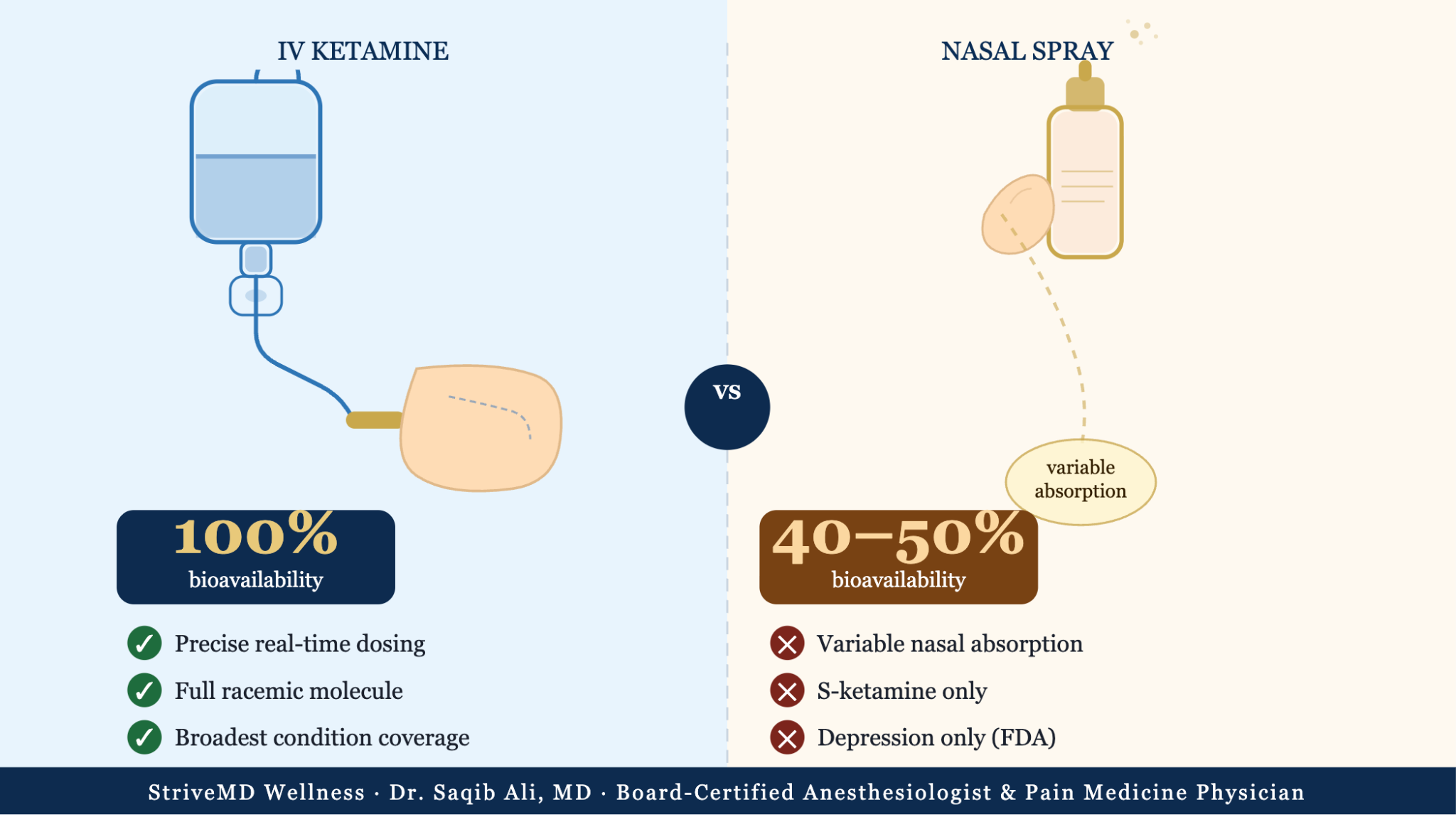
Intravenous ketamine therapy involves the direct administration of racemic ketamine — containing both the R and S molecular forms of the drug — into the bloodstream through a small IV catheter. Because the medication bypasses the digestive system entirely and enters circulation immediately, the bioavailability of IV ketamine is 100 percent. Every milligram of medication prescribed is the exact milligram that reaches your brain.
IV ketamine infusions are administered in a controlled clinical setting under continuous medical supervision. At StriveMD, every treatment plan is personally overseen by me — a physician whose entire specialty is built around the safe, precise administration of intravenous medications. Your heart rate, blood pressure, oxygen levels, and neurological response are monitored throughout the entire session, and your dose is carefully titrated to your individual physiology, body weight, and treatment goals.
The standard IV ketamine protocol for treatment-resistant depression, PTSD, and anxiety consists of six infusions administered over two to three weeks, with each session lasting approximately 45 to 60 minutes. For chronic pain conditions including CRPS, fibromyalgia, and neuropathic pain, infusions may run longer and protocols may differ based on your specific diagnosis and response.
What Is Ketamine Nasal Spray (Spravato)?
Esketamine nasal spray — sold under the brand name Spravato — was approved by the FDA in 2019 specifically for treatment-resistant depression and major depressive disorder with suicidal ideation. It contains only the S-ketamine enantiomer, which is one of the two molecular components found in IV ketamine.
Spravato is self-administered by the patient under supervision at a certified healthcare facility. Patients insert the nasal device and inhale the medication themselves, after which they are observed for approximately two hours before being cleared to leave. The initial treatment schedule typically involves twice-weekly sessions for four weeks, followed by weekly sessions, and then maintenance dosing every one to two weeks.
While Spravato represents a meaningful step forward in making ketamine-based treatment more widely accessible, there are significant clinical limitations that patients deserve to understand before making their decision.
The Critical Differences — Why IV Ketamine Delivers Superior Results
1. Bioavailability — The Most Important Factor Most Patients Never Consider
This is where the clinical difference between IV ketamine and nasal spray is most stark, and as an anesthesiologist it is the factor I feel most strongly about.
IV ketamine has 100 percent bioavailability. When we prescribe a specific dose, that precise dose reaches your bloodstream and crosses the blood-brain barrier. There is no variability, no loss, no guesswork.
Esketamine nasal spray has an average bioavailability of only 40 to 50 percent — and that number varies significantly from patient to patient based on nasal congestion, anatomical differences, how the device is inserted, whether the patient has allergies or a deviated septum, and even how much of the medication is swallowed rather than absorbed through the nasal mucosa. In practical terms, two patients receiving the identical Spravato dose may be getting very different amounts of active medication into their bloodstream.
For a treatment whose effectiveness is closely tied to achieving precise therapeutic blood levels, that variability is a meaningful clinical limitation.
2. Precision Dosing and Real-Time Titration
As a board-certified anesthesiologist and pain medicine physician, precision is not just a preference — it is the foundation of my specialty. With IV ketamine, I can adjust your dose in real time based on how you are responding during the infusion itself. If you need a slight increase to achieve the optimal therapeutic window, or a reduction to ensure maximum comfort, I can make that adjustment immediately and with complete accuracy.
With nasal spray, once the medication is administered the dose is fixed. There is no ability to titrate, adjust, or respond dynamically to how the patient is feeling in the moment. For patients with complex medical histories, sensitivity to medications, or highly individual responses to treatment — which describes the majority of patients seeking ketamine therapy — this lack of flexibility is a significant disadvantage.
3. Speed and Depth of Effect
IV ketamine reaches peak plasma concentration within minutes of administration, producing rapid and reliable therapeutic effects. Many patients begin to notice meaningful mood improvement within hours of their first infusion. The depth and consistency of the therapeutic experience with IV administration is simply unmatched by any other delivery method.
Nasal spray, due to its variable absorption and lower bioavailability, typically produces a less intense therapeutic experience. While some patients respond well, clinical data consistently shows that IV ketamine produces faster, deeper, and more durable antidepressant effects — particularly in patients with severe, long-standing treatment-resistant depression.
4. The Full Molecule vs. Half the Molecule
IV ketamine contains racemic ketamine — both the R-ketamine and S-ketamine enantiomers. Emerging research suggests that R-ketamine may play an important independent role in the antidepressant and neuroprotective effects of ketamine therapy, potentially contributing to more durable outcomes. Spravato contains only S-ketamine, meaning patients receiving nasal spray are receiving half of the molecular profile that IV ketamine delivers.
This is not a minor distinction. As the science of ketamine continues to evolve, the clinical significance of the full racemic molecule versus a single enantiomer is an active and important area of research — and the preliminary evidence increasingly favors the complete molecule.
5. Conditions Treated — IV Ketamine Is Far More Versatile
One of the most significant practical differences between IV ketamine and Spravato is the range of conditions each can address.
Spravato is FDA-approved exclusively for treatment-resistant depression and major depressive disorder with suicidal ideation. That is the full scope of its approved indication.
IV ketamine, by contrast, has demonstrated meaningful clinical benefit across a much broader range of conditions including PTSD, generalized anxiety disorder, OCD, bipolar depression, postpartum depression, CRPS, fibromyalgia, neuropathic pain, migraines, and emerging applications in long COVID. For patients whose suffering does not fit neatly into a single diagnostic box — which is most people — IV ketamine's versatility is a profound advantage.
6. Medical Supervision and Safety
When you receive an IV ketamine infusion at StriveMD, you are under the direct, continuous care of a board-certified anesthesiologist and pain medicine physician who is also an oral board examiner for the American Board of Anesthesiology — the physician body responsible for certifying the next generation of anesthesiologists in this country. That level of expertise means that every aspect of your infusion, from IV placement to dose calculation to real-time monitoring to emergency preparedness, reflects the highest standard of clinical training available in medicine.
Spravato, while administered in a supervised setting, is self-administered by the patient and does not require the involvement of a physician with specialized IV medication training. For a treatment that involves a powerful anesthetic agent acting directly on the central nervous system, the level of medical oversight genuinely matters — both for your safety and for optimizing your outcomes.
So When Might Nasal Spray Be Appropriate?
In the interest of balance, Spravato does have a meaningful role for certain patients. Its FDA approval makes it more accessible through insurance coverage for treatment-resistant depression, which is a genuine practical advantage for patients facing financial constraints. For patients who have a documented contraindication to IV placement or who cannot access a physician-led IV ketamine practice, Spravato represents a reasonable alternative worth discussing with your provider.
However, for patients who want the most clinically effective, precisely dosed, medically supervised, and versatile form of ketamine therapy available — IV ketamine administered by an experienced, board-certified physician remains the gold standard. Full stop.
The Bottom Line
The difference between IV ketamine therapy and ketamine nasal spray is not simply a matter of convenience or preference. It is a difference in bioavailability, precision, depth of effect, molecular completeness, range of treatable conditions, and the level of medical expertise overseeing your care.
At StriveMD, I offer IV ketamine therapy because I believe my patients deserve the most effective, evidence-based, and carefully supervised treatment available. If you have been struggling with treatment-resistant depression, PTSD, chronic pain, anxiety, or long COVID symptoms — and you want to understand whether IV ketamine therapy is right for you — I invite you to schedule a personal consultation.
Your healing deserves the highest standard of care. That is exactly what we are here to provide.
Dr. Syed Ali is a board-certified anesthesiologist and pain medicine physician practicing at StriveMD Wellness. He serves as an oral board examiner for the American Board of Anesthesiology. To schedule a consultation, contact StriveMD directly or complete the appointment request form on our website.